Saturday, April 27, 2013

Spring Excitement

Posted on Bay Hay & Feed's sign board last week....


Thursday, March 14, 2013

Adventures in Foraging


Several years ago, one of my friends was invited to a four course meal prepared by Bainbridge Island's most famous chef, Greg Atkinson.  I couldn't wait to hear what she had for dinner.  After all, Greg was Head Chef at Canlis in Seattle for many years, the author of several cook books, and was known for delicious, innovative preparation of local food. He and his wife recently opened Restaurant Marche on Bainbridge and it is quickly becoming a destination restaurant. 

Imagine my surprise when she told me that the first course was Nettle Soup!  Stinging Nettle Soup, I clarified? I loved Greg's use of local ingredients, but this seemed like it was going too far. I had been stung too many times to ever think of this plant as an edible.

But then my daughters went to Islandwood, Bainbridge Island's incredibly cool Environmental Learning Center, and came home with tales of eating stinging nettles too. My oldest, Emily, loved showing me how to carefully pick and fold the nettle leaf, so as not to get stung.  And then eat it.  It tasted like a green bean, only sort of electrified.

tender, new stinging nettle shoots
Suddenly this whole nettle-foraging-thing seemed like a giant challenge for me.  Nettles are incredibly nutritious and they are everywhere in our woods.  And I must admit that plucking their stinging heads seemed like nice payback for all of the stings I've received over the years.  So, armed with long sleeves, gloves and clippers,  I harvested my first batch of tender, succulent stinging nettle.  That was two years ago, and our soup was so successful, that it's now an annual Adventure in Foraging.

And in keeping with St. Patrick's Day, nettle soup is a delicious "green" soup.  This recipe was given to me by the Garden Educator at Islandwood and is now my favorite.  Highly nutritious, and actually really tasty--be brave and give it a try!


Stinging Nettle Soup (Langdon Cook's version)

4 tbsp butter
1 medium to large Walla Walla Sweet or yellow onion, diced
3 medium potatoes (yukon gold or similar), peeled and cut up (1/2 inch dice)
2 cups chicken or veggie stock
2 cups water
1 large bunch of stinging nettles, rinsed (a colander full/ no need to be precise, it cooks down like spinach)
nutmeg or other spices you like
salt and pepper to taste
heavy cream and/or parmesan (optional)

1. Saute the onion in butter over medium heat until caramelized.  Add a pinch of sugar to help with the process.
2. Add the garlic and potatoes and cook several minutes, until potatoes are lightly browned.  Spice to taste.
3. Add stock and water, raise heat, and simmer until potatoes are tender.
4. Add the nettles, stir and cover.  Cook 10 to 15 minutes on a low simmer. Puree in blender, food mill or processor, then return to the pot.  an immersion blender works well.  Add more stock or water if necessary.  Check seasoning. Serve with a drizzle of heavy cream or parmesan on top if you like.
5. Enjoy!


Sunday, January 27, 2013

New Year's (for Goats)


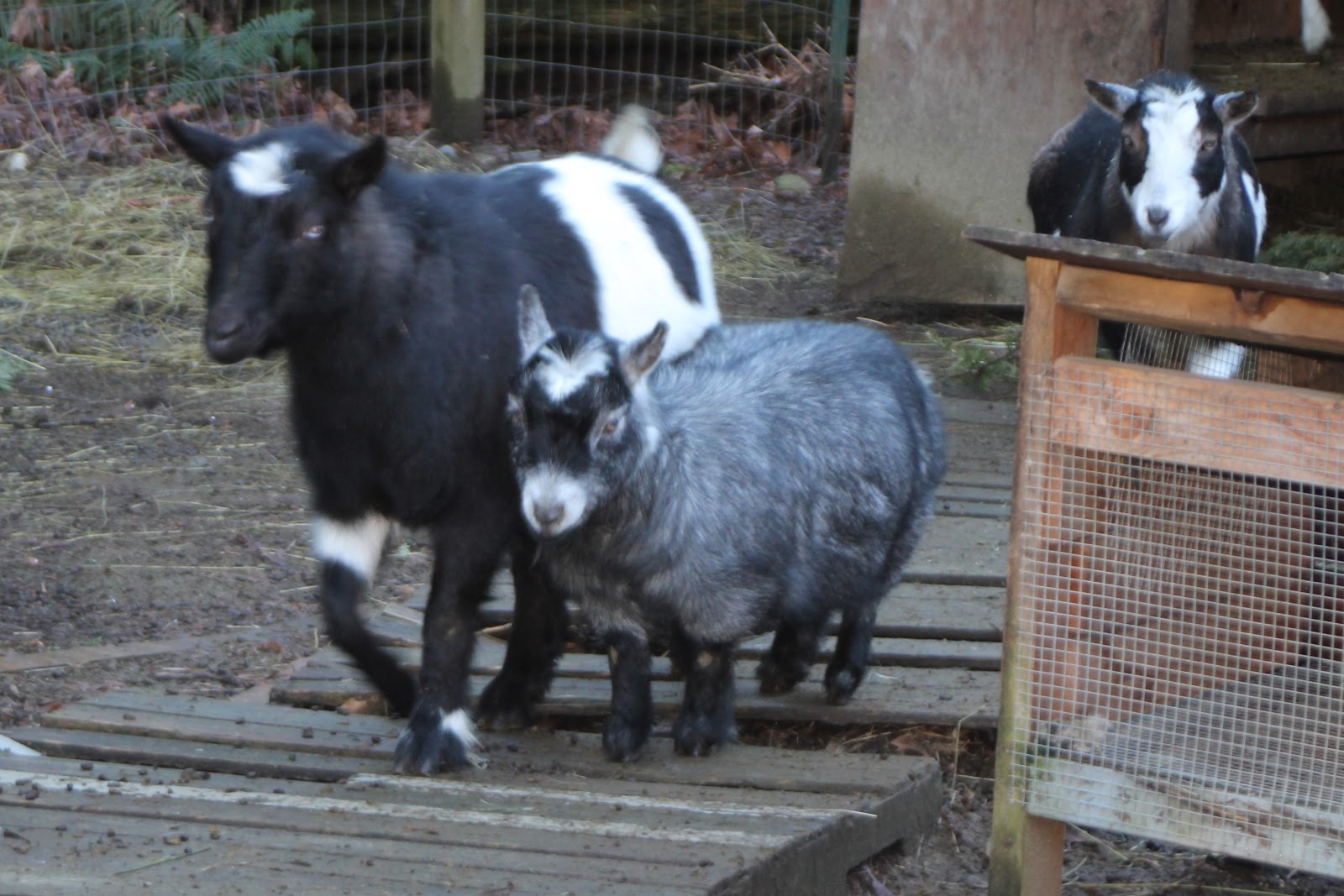
The New Year means nothing to goats. Honestly, they have no idea when we have a holiday, nor do they care.  They celebrate other things. Sunny days for instance, are cause for celebration for them. And food.  And really that's about all I can think of...

They are such creatures of habit and so food-centric, that even their morning feeding of timothy hay is exciting. When I have a treat for them--tortilla chips, stale cereal, or raisins--they are very happy. But the biggest excitement by far is Christmas tree recycling month...going on right now.
Running out to eat a newly delivered tree

Evergreen trees are their favorite treat of all. If they escaped into my garden, my expensive hinoki cypress would be turned into a tree carcass in record time.  So luckily we have several friends who like to "goat-cycle" their christmas trees, and the goats have about a month each year of evergreen bliss.

So far, they've eaten most of four trees and we have three more waiting for them. It's a win-win for all of us. We get a very convenient and earth-friendly way to dispose of our tree, and the goats get to eat loads of their favorite food.

So I suppose that goats do indeed celebrate the New year. But let's be honest...it's all about the food.


Tuesday, December 4, 2012

A Real Christmas Tree


After finishing up our Christmas tree adventure for the year, I felt this article deserved a reprint.  I wrote this a few years ago when the girls were younger, but strangely, even though the girls are older, this still feels appropriate.  Oh, and we found our tree in the pouring rain this year, and I mean pouring.  Our tree still seems to be "over-decorated"-- even with teenaged girls, and my husband still requires a drink or two to handle "lighting issues"... 


I recently read a fascinating article describing how to decorate a Christmas tree.  The article was helpful and full of good ideas, but it discussed things my family just doesn’t put on our tree.  Adornments like fabric, fake birds and carefully tied bows.  I read this article and examined the pictures of the gorgeous trees.  I looked at our tree—no fabric, bows, or fake birds and vowed not to be overcome with tree envy.

For starters, a real Christmas tree needs at least a couple of little children-- better if you have more--putting all of their favorite ornaments on one branch.  It’s best if the branch hangs really low.  So low in fact, that you stare in awe at how the ornaments are not cascading in a slow slither off the branch and onto the floor.  It’s also good to have strings of popcorn and cranberries (also done by the children) looped around branches.  And glittering paper stars, made at preschool, laying wherever they’ve been tucked into the tree by small sticky hands.  We, the grown-ups, are given the top half of the tree, but considering how much work goes into the packing and unpacking of each ornament, and how quickly the season goes with piano recitals, Christmas pageants, school parties, gift buying and cookie baking, my husband and I don’t have the energy to hang more than five of our favorites – maybe ten.  So our tree has this wonderful asymmetry; the bottom half drooping with treasures and the top half relatively bare.

The other element in a real Christmas tree is that there must be strings of lights that don’t work and quietly muttered curses by the designated tree lighter.  In our house, we all implore my husband, the tree lighter, to use more lights.  And here we are in complete agreement with the article I read.  It suggested wrapping each branch in lights for a “lit from within” appearance.  My husband tries very hard at this.  First he tests strands of lights, and find that they don’t work as he has prophesied.  He then makes his annual trip to the hardware store for more lights and begins the lighting process.  There is muttering and cursing from our tree lighter, and clamoring for more lights from the children and myself.  A couple of hours and two stiff drinks later, and the tree and my husband are both well “lit from within”.

Now, according to the article I read, it’s very important to drape and tuck the fabric into the tree.  It sounded like this was a common practice, and it was simply a question of which fabric to use and how best to drape it.  I have never put fabric on our tree.  It looked gorgeous in the pictures.  But I wonder if it belongs on my family’s tree.  For if there is beautiful fabric woven throughout the branches, where would you put the dolls, the fairy wands, the gluey, glittery artwork of the children?  We have only girls in our home, but I imagine a whole host of other things that could be stashed in a tree—toy cars, little animals, and favorite clothing items.  I think you can be really creative in this area.

A real Christmas tree comes with some serious exhaustion for the grown ups, and some serious joy for the children.  And I didn’t see exhaustion in the photographs of the designers—they looked as beautiful as their tree.  And I didn’t see any scratches on their arms from branches, or drinks in their hands from “lighting issues”.  So, I think they must not spend enough time on the Christmas tree process.              

At our house, we still visit a tree farm.  We drive by loads of beautiful, already cut down and ready to go trees, for the prospect of walking through mud, rain or snow, and circling around various “not quite right” trees, until finally we spy the one we all like.  The one we envision in our living room, looking perfect hours (and hours) later.  A proper search takes a good part of a day in itself.

I have many, much wiser friends who have gained some insight into the season.  This knowledge has led them to purchase another sort of Christmas tree altogether.  They have purchased Fake trees.  A completely forbidden concept at our house, but one in which I see a lot of good sense.  One of my girlfriends has a tree that is already lit and decorated.  She has a large storage box for it, and when it is time to put up the tree, she gets out the box and pops it open like a large umbrella.  The layers of fake greenery, lights and ornaments all sort themselves out into a beautiful sight—much like how the tree grows in the Nutcracker Ballet.  The whole process from start to finish takes something like 12 minutes—and that includes the time spent to go to the garage and get the thing.  I can’t say I don’t find that process appealing.

But in our home, we can’t let go of the tradition of a real Christmas tree.  We hunt through the woods (a farm really), we argue about which tree, we have group indecision, we feel the cold, and sometimes the sun, and sometimes the rain or snow.  We arrive at a decision that we all agree on, and then we are all both tired and excited.  We love our tree.  Our girls are as attached as if we were bringing home a puppy.  The decorating process naturally includes some bickering, some “this is my area of the tree” clashes, and so forth.  The branches droop with homemade treasures. The dolls get stashed, as do pictures of the girls when they were babies and toddlers.  My husband truly gets frustrated with the lights and vows to invent lights that work past one season.  We really do have a drink when it’s all finished, and yes it really is to calm and soothe.  And when we turn out the lights and plug in our Christmas tree, it really is a thing of beauty.  Decorations fashioned by the hands of my family in all their imperfect perfection.  This is our real Christmas tree.            

Wednesday, September 26, 2012

Japanese Anemone--a Fall favorite


Anyone who spends enough time in the Pacific Northwest learns that summer does not begin in June; and in fact, June is quite simply a disappointment.  But September is something else altogether.   Our summers may not begin until after the 4th of July, but they linger well into what many people think of as Fall.  And this year has been spectacular!  We've had day after day of 75 degree weather and clear blue skies.  Which is, to put it mildly, very distressing to the school children now locked into classrooms.  But that will be a conversation for another blogpost...


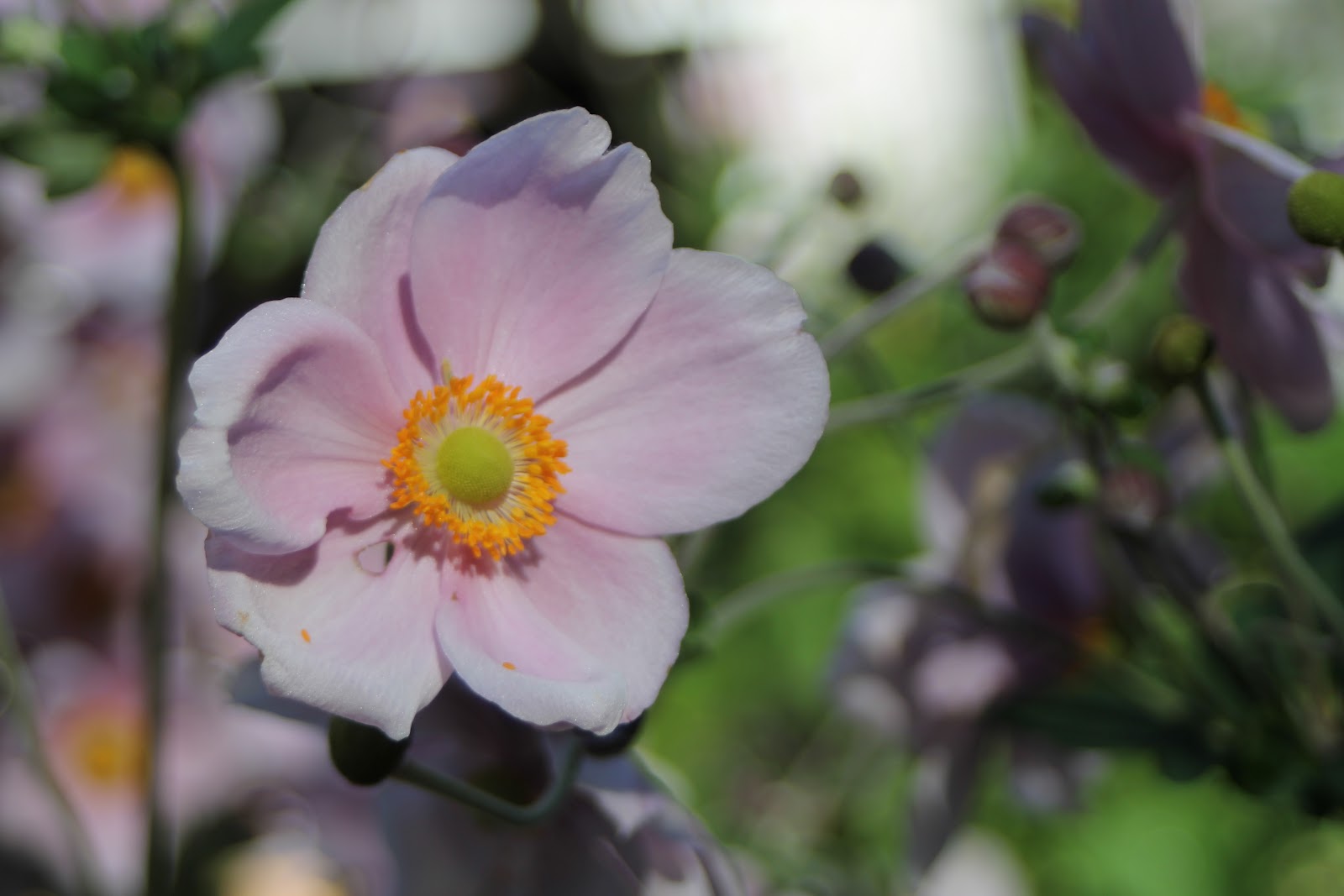
This weather pattern makes it very easy to have a late summer garden full of color in the Northwest, and a plant that never disappoints is the japanese anemone.  The blooms are born on top of tall stems which float above the garden.  And the flowers dance along with any breeze, true to their common name of "wind flower".

A cheery mass of pink anemones
This anemone is also drought tolerant and shade tolerant--two garden conditions that are frequently challenging.  It's happy in both the woodland garden and in a partially sunny garden border,  naturalizing easily so you will have plants to share.  I have never observed this plant to be aggressive or invasive, so definitely accept any "free" anemones your garden friends are offering.


Beautiful in white...


White anemones naturalized in a woodland garden 
With no rain in sight, I continue to water the annuals and pots and enjoy the fall flowers.  The rain will come again soon enough, and in the meantime, a morning cup of tea on the deck is a daily gift.

Saturday, September 15, 2012

Bon Bon

Bon Bon


Bainbridge Island is home to Bon Bon, the sweetest candy store.  It's the sort of place young children dream about.  And the heady scent of chocolate and sugar brings back fond memories of my own candy-infused childhood.

Lisa, the equally sweet owner and head fudge baker, makes several varieties of homemade fudge daily.  I've sampled more than I'll admit to, and still don't really have a favorite.  (Though I would encourage anyone to try her dark chocolate fudge with sea salt and caramel--truly a slice of heaven.)  

For our three daughters, an afternoon in Winslow is not complete without a stop at BonBon for salted caramels, sour patch and a piece of fudge.  And when I want something special for Easter or Valentine's Day, like homemade fudge and caramels, locally crafted truffles, or chocolate covered espresso beans, this is where I go too.  


So this past Spring, when Lisa asked me if I could help her brighten up the outside of her shop with some colorful planters, I was thrilled.  Designing and planting pots is one of my favorite garden jobs, and I knew that working with Lisa would be a joy.

She knew that she wanted lots of bright red geraniums, black planters and a "french" theme.  So, with candy as my guide, and visions of french gardens in my head, I designed these containers.  It was a thoroughly enjoyable project. The planters filled in nicely over the summer, though the boxwoods will continue to look better as they grow.

Here are a few pics, and be sure to check out her website:  Bon Bon Candies


Saturday, August 25, 2012

Lavender Harvest


I have one very scraggly looking lavender plant.  It is in the corner of the herb garden, tucked between a very healthy and rather aggressive lemon balm, and rampant, self-seeding parsley.  I'm not sure how this lavender has survived its years between such over-bearing neighbors, but somehow it persists.

Our climate is barely suitable to lavender but I try because I love this plant dearly.  And even though mine doesn't look anything like the lovely plants up in Sequim, WA, this one plant manages to give me enough lavender every year to make fragrant, long-lasting bouquets.

How lavender is supposed to look, Courtesy of the Sequim, WA Lavender Festival

I won't post a picture of my plant--truly the poor thing is nothing to look at.  But I do have fun with the lavender I harvest.  Like so many people, I am drawn to its soft fragrance.  My initial $3 investment (of many years ago) and 15 minutes of annual trimming is enough to make pretty vases of lavender.  By far this is the easiest and most rewarding of harvests.